Insight
The attention-and-review trap in district administration
District administrations can execute at extraordinary scale, yet chronic public problems often get trapped in cycles of targets, reviews and instructions instead of diagnosis, evidence and learning.
2026-08-03 / Ankush Singh
governance, public administration, district administration, policy implementation
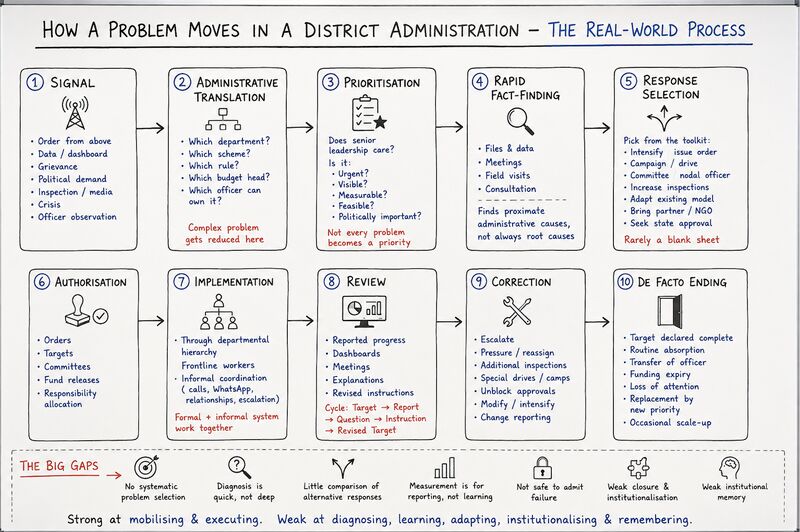
A district administration can conduct elections involving lakhs of people. It can manage floods, handle law-and-order situations, respond to crises, and run large campaigns within a matter of days.
But the same administration often struggles to solve problems like malnutrition, school dropout, poor health services or water insecurity, even after years of programmes and spending.
What I am increasingly seeing is that, at the district level, problems do not usually move through a proper problem-solving process. They move through an attention-and-review process.
How the problem gets reduced
A problem first comes into notice through something: a grievance, political pressure, an inspection, a crisis, a media report or simply something an officer notices during a visit.
Then the system tries to translate it into administrative language.
Which department owns it? Which scheme can cover it? Where is the budget? Who can be asked to act?
This is necessary, of course. But this is also where a complex problem often gets reduced.
Malnutrition becomes food distribution. School dropout becomes enrolment. Poor health services become staff attendance. Water insecurity becomes the number of connections.
Then the problem competes for attention. It gets priority if it is urgent, visible, politically important or being reviewed regularly by someone senior.
After that, files are called, data is reviewed, officials are questioned and a few field visits may happen. The diagnosis usually becomes familiar: funds are delayed, staff are absent, monitoring is weak or departments are not coordinating.
All of this may be correct. But it may still not explain why the problem continues.
The familiar administrative toolkit
The response then comes from the familiar administrative toolkit: issue an order, set a target, launch a campaign, increase inspections, appoint a nodal officer, bring in an NGO or a tech partner.
Implementation is pushed through the hierarchy and reviewed through meetings, dashboards, phone calls, deadlines and WhatsApp groups.
The cycle becomes:
- Target
- Report
- Questioning
- Instruction
- New target
Instead of:
- Problem
- Diagnosis
- Hypothesis
- Intervention
- Evidence
- Learning
- Redesign
And then, in most cases, the initiative does not really close. The target is declared complete. The officer gets transferred. The funding ends. A new priority comes. Reviews become less frequent. Attention moves somewhere else.
The real gap
Government is not inactive. In fact, it is constantly acting.
But it does not always have an institutional process for understanding what exactly the problem is, why it is persisting, what the real constraint is, which response is likely to work here, what the evidence showed, what should be changed and what should continue after the officer leaves.
Government has already shown that it can execute at an extraordinary scale. The missing capability is often the slower institutional process of diagnosis, learning, adaptation and memory.
Originally shared on LinkedIn.