Insight
Money without diagnosis becomes activity
Funding matters, but patient diagnosis is often what turns public spending into visible movement on outcomes.
2026-08-25 / Ankush Singh
governance, philanthropy, public systems, diagnosis
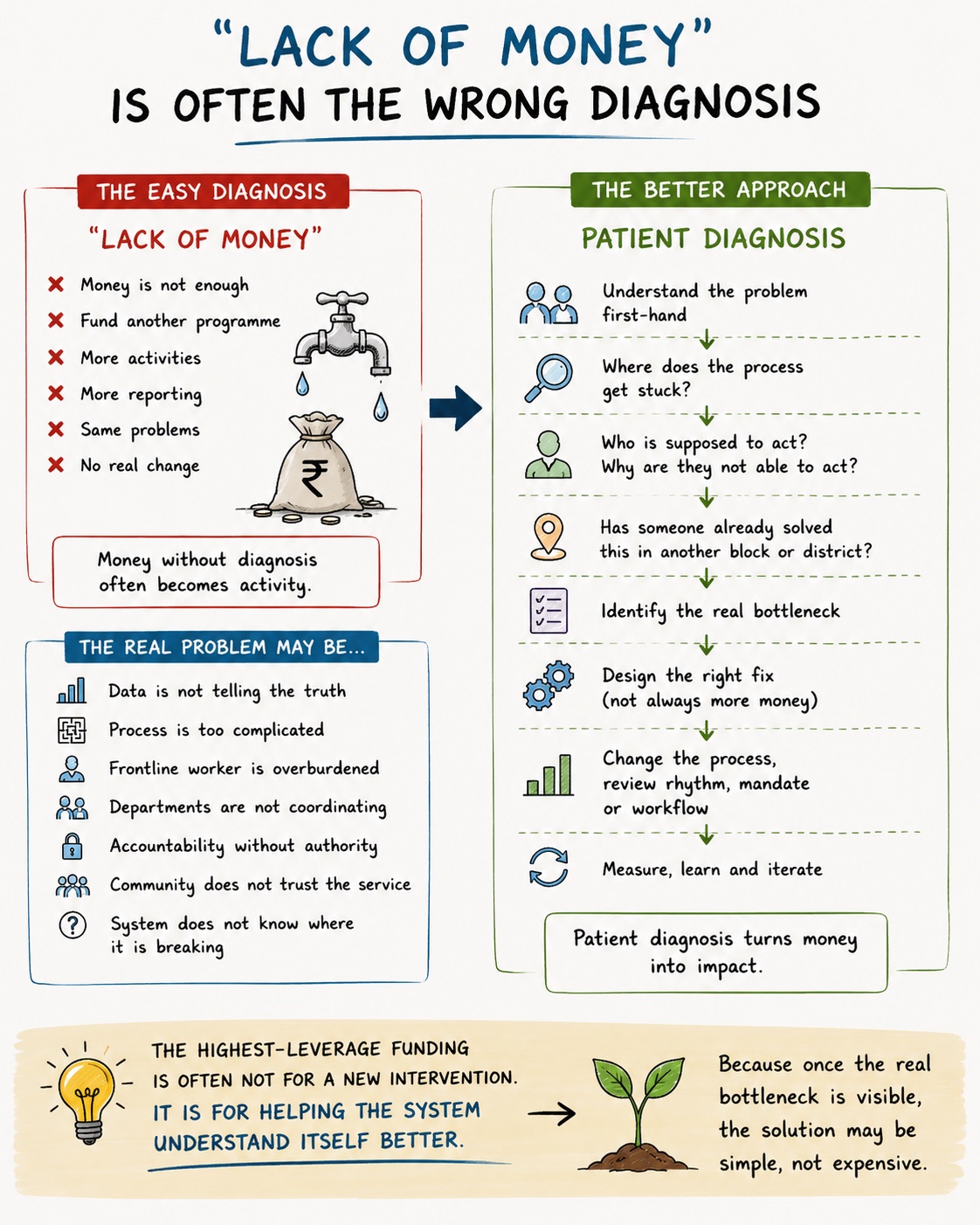
In governance, lack of money is often the easiest diagnosis.
But many times, it is not the right one. The money is there. The scheme exists. The guidelines exist. The staff exists. The review meetings are happening.
And still, the outcome does not move.
That is when we need to pause. Because the real problem may be somewhere else. Maybe the data is not telling the truth. Maybe the process is too complicated. Maybe the frontline worker is overburdened.
Maybe two departments are supposed to coordinate, but nobody actually owns the coordination.
Maybe the person responsible has accountability, but not authority. Maybe the community does not trust the service. Or maybe the system simply does not know where exactly it is breaking.
Why patient diagnosis matters
Before funding another programme, we need to understand the problem properly.
Not only from the file. Not only from the dashboard. But from the field.
Where does the process get stuck? Who is supposed to act? Why are they not able to act? Has someone already solved this in another block or district?
Funders often like programmes because programmes are visible.
Diagnosis is slower. It looks less exciting. But without diagnosis, we keep funding solutions to problems we have not fully understood. Sometimes the highest-leverage funding is not for a new intervention.
It is for helping the system understand itself better.
Because once the real bottleneck is visible, the solution may not need a large budget.
It may need a simpler form. A changed workflow. A better review rhythm. A clearer mandate. Or one person inside the system who finally owns the problem.
Money matters.
But money without diagnosis often becomes activity. Patient diagnosis is what turns money into impact.
Originally shared on LinkedIn.