Insight
The best-practice trap in governance reform
Governance reform often imports new models, pilots and innovations without first asking whether the existing system has the capacity to absorb them.
2025-12-07 / Ankush Singh
governance, public policy, institutional capacity, state capability
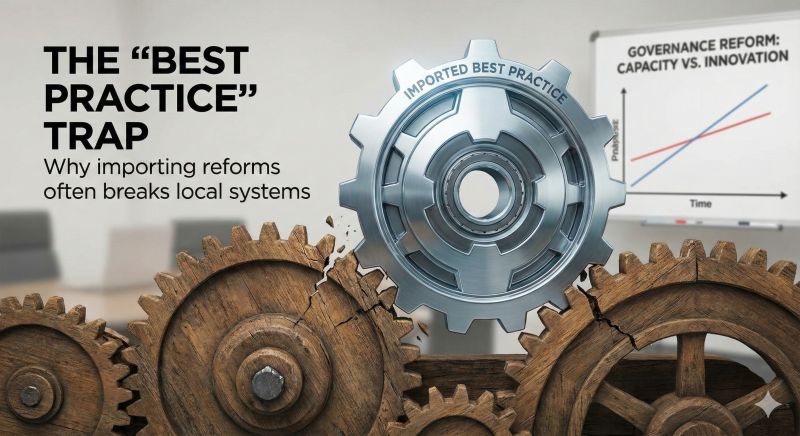
Over the past few months, I have been diving deep into literature on governance and reform. One insight keeps surfacing again and again: our obsession with importing best practices is often making governance worse, not better.
Across governments, philanthropies and development agencies, there is an urge to fix problems by introducing new models, new pilots and new innovations, usually borrowed from other countries or contexts.
But very rarely do we pause to ask a fundamental question: can the existing system actually absorb these changes?
Capacity before innovation
India is a telling example. While the country sits somewhere in the middle globally on governance performance, several long-term indicators suggest that the quality of governance has been under strain since the early 1990s.
This period also coincided with an influx of reforms, ideas and externally inspired solutions.
The intent was progress. The outcome, too often, has been increased strain on an already burdened administrative machinery.
The lesson is simple but uncomfortable: reforms that ignore capacity end up weakening the system they aim to improve.
The problem is not a shortage of ideas. It is a shortage of realistic assessments of what the system can bear.
The next frontier
Perhaps the next frontier of governance innovation is not more innovation.
It is restraint, diagnosis and respect for institutional capacity.
Before asking what new model should be introduced, reformers need to ask what work the system is already carrying, where capability is thin, which routines are overloaded and what kind of change the institution can genuinely sustain.
Best practices matter only when they are translated into local capacity. Without that translation, even good ideas can become additional administrative burden.
Originally shared on LinkedIn.