Insight
What if the problem is already solved somewhere?
Positive deviance asks a different governance question: where is the system already working, and what can be learned from the people or places succeeding under similar constraints?
2026-04-08 / Ankush Singh
governance, positive deviance, public policy, systems change
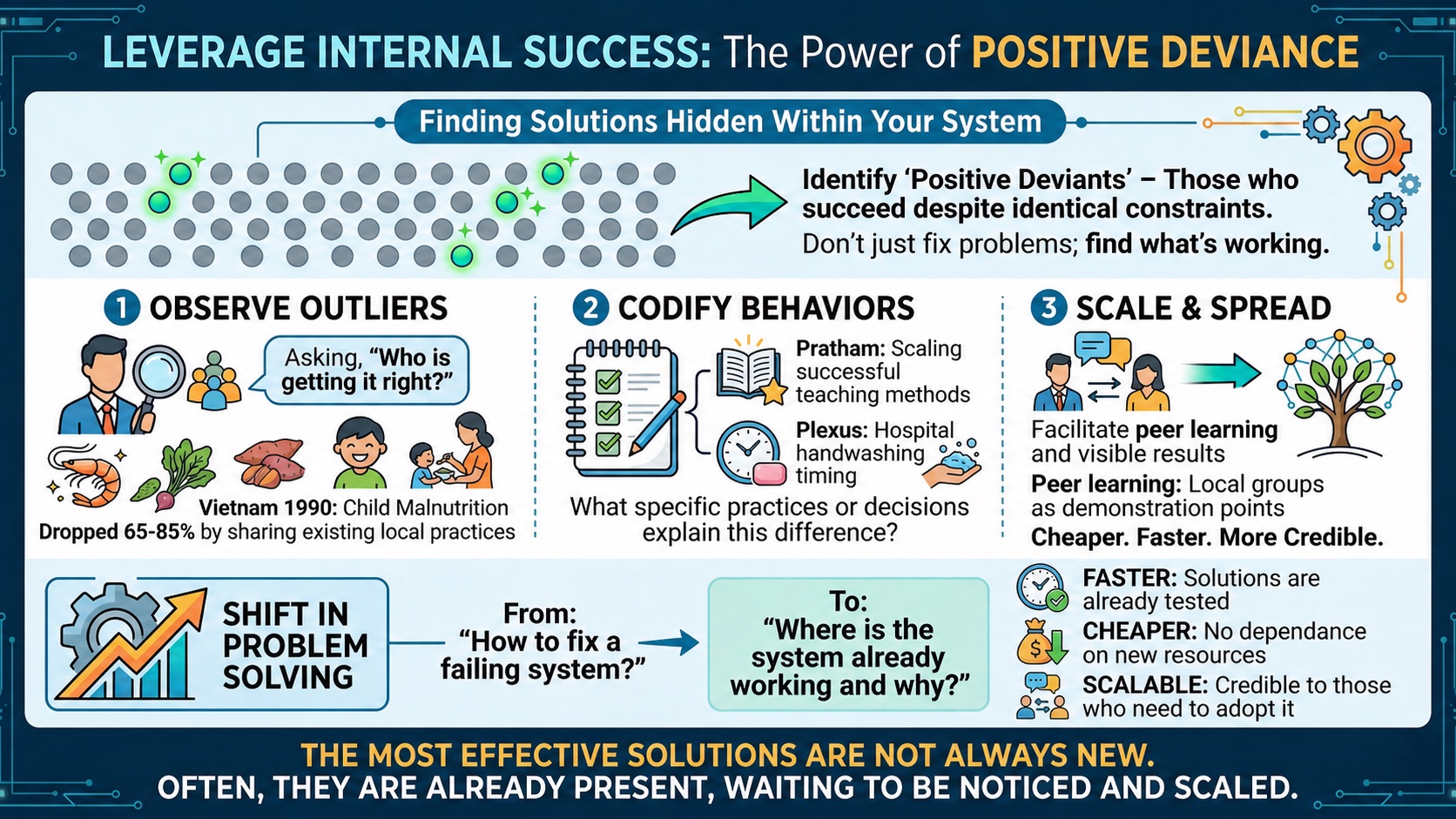
Most development programmes start with the same assumption: solutions need to be designed and brought in from outside.
That assumption is often wrong.
In 1990, a team working on child malnutrition in rural Vietnam asked a different question. Instead of asking only what was going wrong, they asked whether anyone in the same village, with the same constraints, was getting it right.
They found a small number of families whose children were well nourished despite having similar income, food access and living conditions.
These families were not doing anything extraordinary. They were doing a few simple things differently. They fed children small shrimps and sweet potato greens that were locally available but culturally ignored. They also fed children smaller quantities more frequently.
No new resources were introduced. No external expertise was imported. Instead, these practices were made visible within the community. Other families observed, tried and adopted them.
Within two years, malnutrition dropped sharply.
This approach came to be known as Positive Deviance.
The core idea
Solutions to complex problems often already exist within the system. They are being practised by a small number of outliers.
The role of leadership is not always to design new solutions. Sometimes it is to identify, understand and spread what is already working.
This has been applied across sectors.
In education, Teaching at the Right Level grew from observing teachers who were already helping children learn despite systemic constraints. Instead of introducing an entirely new pedagogy, the approach codified what was already working and scaled it through government systems.
In healthcare, hospitals working with the Plexus Institute in the United States used Positive Deviance to reduce MRSA infections. They identified wards with unusually low infection rates and studied everyday practices such as handwashing timing and patient handling. These behaviours were then spread within the same hospitals.
In livelihoods and governance, peer-learning models have often grown by making successful local groups visible to others. Groups that are functioning well become demonstration points, and the system grows by replicating internal success rather than importing external models.
The pattern is consistent: same system, same constraints, different outcomes.
The question is whether we choose to learn from it.
A shift in problem solving
Positive Deviance requires a shift in how we approach problem solving.
Instead of asking how to fix a failing system, we need to ask where the system is already working and why.
This shift has three advantages.
It is faster because the solution is already tested. It is cheaper because it does not depend on new resources. It is easier to scale because it is credible to the people who need to adopt it.
However, this approach is not without challenges.
Identifying genuine positive deviants requires careful analysis. It is easy to mistake success driven by hidden advantages for replicable practice.
It also requires going beyond narratives to understand specific behaviours. What exactly is being done differently, and can it be repeated elsewhere under similar conditions?
There is also a risk of misuse. The idea can be used to avoid addressing structural gaps by overemphasizing local solutions. Positive Deviance works best alongside systemic investment, not as a substitute for it.
A practical starting point
For practitioners and policymakers, a simple starting point is to build this into the diagnostic process:
- Which locations or actors are performing better than others under similar conditions?
- What specific practices or decisions explain this difference?
- Can these practices be adopted elsewhere without additional resources?
If the answer to the third question is yes, that may be the highest-leverage intervention available.
The most effective solutions are not always new. Often, they are already present, waiting to be noticed and scaled.
Originally shared on LinkedIn.